
Don't Go To The Gym!
.Have you ever wondered why experts promote exercising outdoors over inside a standard gym? We asked about that too. You may be surprised, as we were, to learn that a significant portion of it has something to do with the color green. Read on and find out.
David & Lovee Miller
9/22/20259 min read
Don’t Go To The Gym
Green environments amplify the physical and mental pay-offs of exercise, providing distinct advantages not typically found in standard gym settings. Consider the impact of beginning the day amidst greenery and fresh air during a sunrise trail walk. The cool, natural sights and scents invigorate the senses, establishing a positive tone for the day. Many individuals prefer outdoor exercise environments over traditional gyms. Research indicates that much of this preference is linked to the presence and influence of the color green.
Are You Curious About:
Outdoor Exercise Health Benefits Compared to Gym Workouts?
Are You Curious About:
The Science Promoting Green Environments?
Are You Curious About:
How our Brain Processes Green Light?
Are You Curious About:
Why Green Light Turns on the Parasympathetic Relaxation Response?
Don’t Go to the Gym!
You probably haven't heard your doctor say that. (Or suggest more pizza, either.)
Introduction: Why the Environment Matters in Exercise
Everybody knows that exercise is essential for health—physical, mental, and spiritual—but where we choose to move may matter just as much as how. While gyms provide structured training environments, outdoor exercise offers unique benefits that go far beyond physical fitness. Recent research shows that exercising in natural green environments not only improves strength and endurance but also enhances mental well-being, relaxation, and cognitive performance. ("Psychological benefits of green exercise in wild or urban green spaces: A meta-analysis of controlled trials", 2025) Something we found curious while researching this topic is that exposure to the color green—dominant in nature—has a powerful, independent effect on the autonomic nervous system, particularly the parasympathetic system, which regulates relaxation and stress recovery. (van den Berg, 2015) Incorporating “green” into your exercise has some heretofore unrecognized benefits. Let’s dig deeper by first comparing outdoor exercise to gym workouts.
Outdoor Exercise vs. Gym Workouts: A Comprehensive Comparison
Physical Health Benefits of Outdoor Workouts
· Good for your heart: Outdoor activities, as simple as just hiking (or more vigorous workouts such as running, cycling, or bodyweight training in a park), provide cardiovascular conditioning, muscular strength, and endurance. The challenges posed by uneven open surfaces make greater demands on the heart for aerobic activities. For those interested in maximizing their cardiovascular workouts, aim for a heart rate zone of 50-70% of your maximum heart rate during moderate activities like hiking and 70-85% for more intense activities like running or cycling. ("Exercise - Overall Conditioning, Cardiovascular Health, Strength Training", 2025)
· Good for your lungs: There’s also little doubt that your lungs prefer fresh-smelling, clean air for maximum performance and enjoyment.
· Good for your muscles: Navigating over uneven terrain activates proprioceptors within our muscles, which activate and recruit additional muscle to ensure balance and coordination. ("Biomechanics and energetics of walking on uneven terrain", 2024)
· Good for your bones: Sunlight exposure also helps regulate vitamin D production, crucial for bone health. (Holick, 2004)
· Good for your immune system: Sunlight exposure that promotes the production of vitamin D also promotes an improved immune system to fight infections and even cancer. Pine trees emit an aromatic compound that, when inhaled by humans, surprisingly stimulates the improved function of certain immune cells. ("Sun Safety and Vitamin D", n.d.) (More about this little fascinating fact in a future video podcast episode)
· Good for your sleep: Sunlight helps stabilize the circadian rhythm by regulating natural melatonin cycles, resulting in improved restorative sleep. ("Why Sunlight Can Help You Sleep Better", 2023)
Physical Health Benefits of Gym-Based Workouts
Gyms, on the other hand:
· provide controlled environments
· specialized equipment for resistance training, high-intensity intervals, and bodybuilding
· excellent for progressive overload and structured muscle developmen
· Indoor workouts are also weather-independent
Accessibility, Affordability, and Convenience Factors
Outdoor workouts are often free and accessible, whereas gyms typically require memberships. However, gyms offer specialized support, from trainers to recovery equipment. Many people find balance by combining both. This balance is especially relevant when considering how different environments affect motivation and adherence to exercise routines.
Motivation and Adherence in Different Environments
Consider the last time you visited a park or lush green space. How did it make you feel? Studies suggest that people are more likely to stick to outdoor exercise because it feels less like a chore and more like recreation. This is because the beauty of nature reduces perceived effort, allowing individuals to work harder without realizing it. Supporting this, one study found that participants who exercised outdoors were 30% more likely to stick with their program after six months compared to those who exercised indoors. ('GO GREEN WITH OUTDOOR ACTIVITY', 2017)
The Mental Health Benefits of Exercising in Green Environments
· Reduction of stress: Being out in nature has been associated with reduced cortisol levels, the principal stress hormone. ("A 20-minute nature break relieves stress", 2019)
· Improved attention, focus, and clarity of thought: Exercising outdoors has been known to raise dopamine levels in the brain. The dopamine neurotransmitter plays a crucial role in enhancing attention, motivation, and cognition, including problem-solving and memory recall. (Curtin, 2024)
· Emotional stability: The combination of less stress (and the consequent expansion of relaxation) and clarity of thought is known to rein in emotional instability.
Exposure to greenery has also been linked to enhanced creativity. Spending time outdoors may help foster new ideas and insights, supporting creative productivity.
· Greater socialization opportunity: Having conversations and meeting new friends is more common in neighborhoods, parks, and along trails.
Consistent exposure to natural greenery is linked to reduced risks of depression and anxiety disorders, indicating a preventative effect on mental health. Urban planners have recognized the advantages of increasing green spaces, citing research showing decreased crime rates in areas with higher greenery density. Early human societies often engaged directly with natural environments.
The Science of Green: How the Visual System Processes Natural Colors
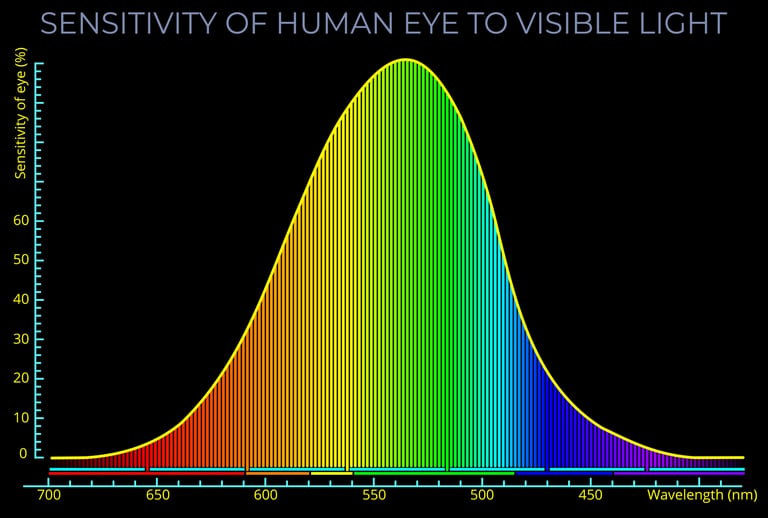
The Human Eye’s Sensitivity to Green Wavelengths
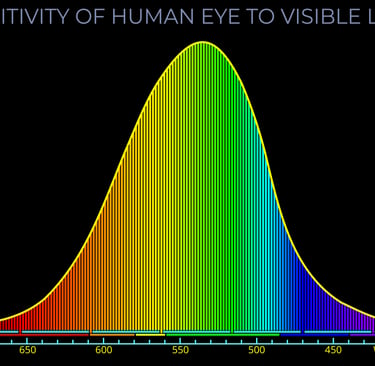
The eye is most sensitive to green light (around 555 nm wavelength), which explains why natural landscapes appear especially vivid and calming. In fact, the color green is situated precisely at the center of the human visual spectrum. ("Spectral Sensitivity of the Human Eye")
Light is processed in the human brain through a defined neurological pathway. Readers who are less interested in neuroanatomy may choose to proceed to the next section.
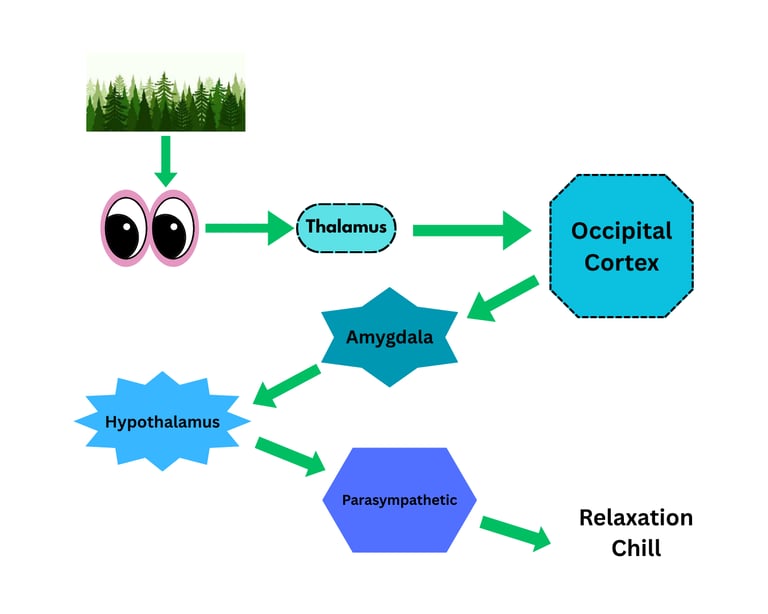
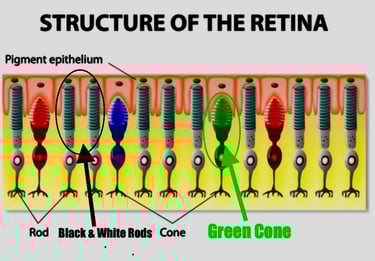
The retina is a sensitive layer of nerves at the back of the eye, comprising rods and cones. The rods detect black and white, especially in dim conditions, while the cones are responsible for color detection. In simple terms, green wavelengths enter the eye, and the information is sent through the amygdala, promoting relaxation.
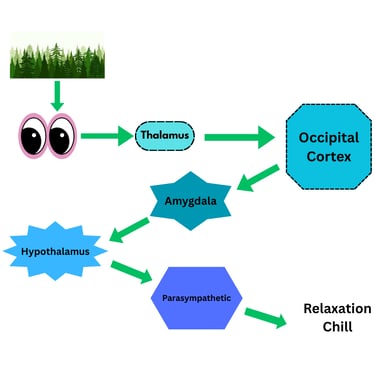
The retina transfers information first to the thalamus, then on to the visual cortex in the occipital part of the brain.
In the specialized zones of the cortex, the perceived colors are processed and acquire specific meanings based on experiences and learning. Then some of the color information, specifically green, is transferred to the amygdala, the part of the brain that regulates emotions. Different colors are processed in separate areas.
The information about green color, having been processed in the amygdala, is forwarded on to the hypothalamus. The hypothalamus is the brain area that regulates the balance between the sympathetic nervous system (fight or flight) and the parasympathetic nervous system (relax and restore). The color green is wired in the brain to specifically activate the parasympathetic system, as well as to tone down the sympathetic system.
In summary, the color green has a direct connection to the brain that promotes the relaxation response and reduces the stress response. This connection was new information to us as well.
The Surprising Universal Connotations of the Color Green
Green vegetation evolved as a key environmental signal for food, shelter, and safety, hardwiring humans to feel secure around greenery and to seek it out. ("Biophilia hypothesis")
Green is globally associated with growth, renewal, and balance, reinforcing its natural soothing effect. Many colors have built-in connotations, such as green meaning "go" at a traffic light. Some associations may be hard-wired, while others are learned through social context.
Practical Ways to Integrate Green Environments into Your Exercise Routine
Running, Cycling, and Hiking in Nature: Great for cardiovascular endurance.
Outdoor Yoga and Meditation in Parks: Combines physical flexibility with mindful relaxation.
Hybrid Fitness Routines (Gym + Nature): Use the gym for strength training and outdoor spaces for cardio and mental restoration. Consider pre-planning your weekly "green anchors" such as a Wednesday trail walk or run alongside gym sessions to encourage consistency. This approach follows the concept of choice architecture, where designing simple defaults makes the healthy choice the easy choice. There is nothing wrong with incorporating some jumping jacks, squats, or push-ups into your hike.
FAQs on Outdoor Exercise, Green Environments, and Nervous System Relaxation
Q1. Is outdoor exercise more effective than gym workouts?
Both are effective, but outdoor exercise provides added mental and nervous system benefits.
Q2. How does the color green reduce stress?
Green stimulates the parasympathetic nervous system, lowering stress hormones and promoting relaxation.
Q3. Can indoor plants provide the same benefits?
Yes, though not as powerful as full immersion in nature, indoor greenery still improves mood and relaxation.
Q4. Does sunlight exposure matter for exercise benefits?
Absolutely. Sunlight regulates circadian rhythms, enhances sleep quality, and boosts mood and energy levels. Sunlight is essential for the production of vitamin D, which has many metabolic functions, not the least of which is its role in strengthening bones.
Q5. How quickly does exposure to greenery affect the nervous system?
Studies show that stress hormone levels (cortisol and norepinephrine) decrease in as little as five minutes after exposure to a natural setting begins. (Hunter, 2019)
Q6. What’s the best balance between gym and outdoor exercise?
A combination works best: gym for structured training and outdoors for relaxation, creativity, and recovery. A gym is tough to beat if you live in a place where it's rainy and 35 degrees.
Conclusion: Why Outdoor Green Spaces Are Nature’s Gym
While gyms are excellent for targeted training, outdoor exercise offers several tangible advantages. The combination of physical exertion, exposure to green environments, and parasympathetic activation provides deeper relaxation, better cognitive performance, and long-term resilience against stress. Whether it’s a jog in the park, yoga under the trees, or simply a walk around your neighborhood, nature truly is the best gym for body and mind. Do you think pulling weeds in the flowerbed counts?
Next time you’re weighing treadmill vs. trail, remember—your nervous system loves the color green, so lace up those hiking boots and give it a try.
Let’s Try This
A few interesting references if you are more curious about this subject
1. Jonauskaite D, et. al Universal Patterns in Color-Emotion Associations Are Further Shaped by Linguistic and Geographic Proximity. Psychol Sci. 2020 Oct;31(10):1245-1260. doi: 10.1177/0956797620948810. Epub 2020 Sep 8. PMID: 32900287.
2. Briki W. ewt al. Adaptiv4 effects of seeing a green environment or psychophysiological parameters when walking or running. Front Psychol . 2019 Feb 12;10:252. PMID: 30809177
3. Akers A. et al. Visual Color Perception in Green Exercise. Environ Sci Technol 2012,46; 16:8661
References
Psychological benefits of green exercise in wild or urban green spaces: A meta-analysis of controlled trials. (2025). Journal of Environmental Psychology, 68.
van den Berg, M.M., Maas, J., Muller, R., et al. (2015). Autonomic Nervous System Responses to Viewing Green and Built Settings: Differentiating Between Sympathetic and Parasympathetic Activity. International Journal of Environmental Research and Public Health, 12.
Exercise - Overall Conditioning, Cardiovascular Health, Strength Training. (2025). Encyclopaedia Britannica. https://www.britannica.com/topic/exercise-physical-fitness/Overall-conditioning
Biomechanics and energetics of walking on uneven terrain. (2024). Journal of Experimental Biology, 216.
Holick, Michael F. (2004). Benefits of Sunlight: A Bright Spot for Human Health. Environmental Health Perspectives, 116.
Sun Safety and Vitamin D. (n.d.). www.cancer.org. https://www.cancer.org/cancer/risk-prevention/sun-and-uv/sun-safety-and-vitamin-d.html
Why Sunlight Can Help You Sleep Better. (2023). sleep.com. https://www.sleep.com/sleep-health/start-with-sunlight-mornings
GO GREEN WITH OUTDOOR ACTIVITY. (2017). ACSM's Health & Fitness Journal, 21.
A 20-minute nature break relieves stress. (2019). Unknown Journal.
Curtin, D., Taylor, E. M., Bellgrove, M. A., Chong, T. T., Coxon, J. P. (2024). Dopamine D2 Receptor Modulates Exercise-Related Effect on Cortical Excitation/Inhibition and Motor Skill Acquisition. Journal of Neuroscience, 44.
Green space exposure on depression and anxiety outcomes: A meta-analysis. (2023). Science of the Total Environment, 880.
Sypion, Natalia (2023). Exploring the Impact of Green Areas on Crime Rates in Urban Environments. European Research Studies Journal, XXVI.
Spectral Sensitivity of the Human Eye. (n.d.). Gigahertz-Optik. https://www.gigahertz-optik.com/en-us/service-and-support/knowledge-base/basics-light-measurement/light-color/spectr-sens-eye/
What Does the Color Green Mean?. (2023). Verywell Mind. https://www.verywellmind.com/color-psychology-green-2795817
Biophilia hypothesis. (n.d.). en.wikipedia.org/wiki/Biophilia_hypothesis. https://en.wikipedia.org/wiki/Biophilia_hypothesis
Best Color For Health Feng Shui. (n.d.). Feng Shui New. https://www.fengshuinew.com/best-color-for-health-feng-shui/
Vitamin D. (n.d.). International Osteoporosis Foundation. https://www.osteoporosis.foundation/patients/prevention/vitamin-d
Hunter, MaryCarol (2019). Just 20 Minutes of Contact with Nature Lowers Stress Hormone Levels. Frontiers in Psychology, 10.



Curiosity is a powerful driving force that often leads individuals to explore the unknown, ask questions, and seek out new experiences that enrich their understanding of the world around them.
Exploring the wonders of life together.
Connect
Learn
loveedavidmiller@gmail.com
123-456-7890
© 2025. All rights reserved.